
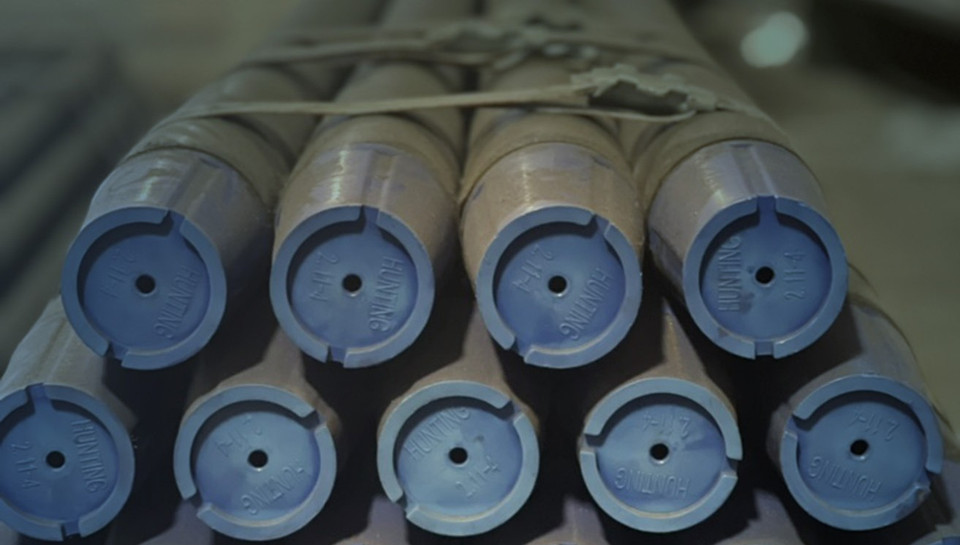
At Georgia Underground Superstore (GUS), we hear this question all the time:
“When’s the right time to replace my drill pipe?”
And we get why it’s such a tough call. On most HDD jobs, drill pipe is one of the largest ongoing expenses you’ll deal with. It’s the most expensive consumable item on many horizontal directional drills, so it’s natural to want to run your drill string as long as possible and get every last foot out of it.
That approach makes sense, until it doesn’t.
Because the moment pipe fails downhole, the real costs show up fast: downtime, added labor, tool recovery attempts, bore salvage, and in the worst-case scenario, the decision to abandon the bore entirely. Suddenly, the money you saved by “stretching it a little longer” disappears in a hurry.
So, how do you know when it’s time?
The “perfect” answer… and the realistic one
If we’re being a little sarcastic, the “perfect” time to replace drill pipe is right before it breaks.
But of course, no one can predict that exact moment with certainty.
What we can do is help you get ahead of failure by learning how to read the warning signs. The more you understand what to look for, and the more consistently you inspect your drill string, the easier that replacement decision becomes.
Drill pipe tells a story, pay attention to it
We’ve seen thousands of drill rods over the years, and one thing is always true:
Every drill pipe tells you what it’s been through.
Wear marks, scratches, slight bends, beat-up threads - those are all signals. And if your pipe looks like it’s been taking hits job after job, it’s probably not a sign of toughness… it’s a sign that retirement is near.
One of the biggest mistakes we see in the field is a crew saying, “It’s rough, but it’s still working.” Sometimes it works, until the pullback that finally proves it doesn’t. And when pipe gives out at the wrong time, the downtime almost always costs more than replacing the rod would have.
Start with what’s simplest: routine visual inspections
If you want the best return on your drill pipe investment, the easiest first step is this:
Inspect your pipe regularly, before it goes downhole.
We always recommend starting with a basic visual check because it’s fast, low effort, and it catches the most obvious issues early.
Here are the key things we look for.
1) Any bend, no matter how small, is a red flag
This one is non-negotiable.
If a rod is bent, even slightly, we recommend pulling it from the string immediately and setting it aside for a closer look.
A bend is typically a sign of oversteering or pushing the pipe beyond its designed bend radius. Once that happens, the steel can lose its ability to return to perfectly straight. In other words, the pipe can “remember” being bent, and that memory doesn’t go away.
Running bent pipe increases stress on the string, impacts steering accuracy, and increases the odds of failure.
2) Watch your tool joints and threads closely
Tool joints take a beating over the life of a rod. The threads tell you a lot.
When we evaluate a pipe, we ask:
- Are the threads still crisp and well-defined?
- Are they starting to round off?
- Do the connections feel sloppy even when properly torqued?
- Are you seeing galling, deep wear, or metal deformation?
If the threads look worn down or the joint is showing heavy damage, the connection is becoming weaker, even if it’s still “making up.”
3) Damage on the body of the pipe matters too
Some surface wear is normal. But deep grooves, severe scarring, and heavy scoring aren’t just cosmetic.
Those marks can become weak points where stress builds, especially under high torque, tough pullback conditions, or repeated drilling in abrasive formations.
If the pipe body is heavily damaged, don’t assume it’s harmless. That damage can shorten the remaining life of the rod dramatically.
Pay attention to what the machine is telling you
A lot of drill pipe problems don’t start with a visible break, they start with subtle changes in the way your drill behaves.
If you notice:
- unusual vibration
- steering becoming unpredictable
- the rig feeling like it’s working harder than normal
- mud flow not behaving the way it usually does
…that could be your drill pipe contributing to the issue.
Your rig gives feedback constantly. When something feels “off,” it’s worth checking the pipe before you assume it’s just ground conditions.
It’s not about calendar age, it’s about how hard the pipe has lived
One of the biggest myths in HDD is that pipe replacement should follow a fixed schedule.
In reality, pipe life depends heavily on what it’s been through.
A rod that’s spent 200 hours cutting through abrasive sand can be more worn out than a rod with 500 hours in soft clay. Just like work boots, pipe wears out faster in harsh environments.
When deciding whether to replace pipe, consider:
- formation abrasiveness
- torque demand
- frequency of oversteering
- pullback loads
- length and difficulty of bores
Those factors determine fatigue and wear far more accurately than “hours alone.”
Our recommendation: replace before failure, not after it
We know it’s tempting to squeeze “one more bore” out of a questionable rod, especially when pipe is expensive.
But with our experience, the cost of downtime, recovery, and unexpected failure nearly always outweighs the cost of replacing pipe at the right time.
If you’re looking at a rod and thinking, “Is this still good?” - there’s a good chance the answer is no.
Replacing drill pipe isn’t just about avoiding failure. It’s about protecting your timeline, your crew’s productivity, and the success of your bore.
Talk to the HDD experts at Georgia Underground Superstore
At Georgia Underground Superstore, we work with contractors every day to help them get the most life out of their tooling and make smart replacement decisions before problems happen. Our HDD experts can help you evaluate drill pipe wear, understand what you’re seeing, and recommend the right next steps based on your rig, ground conditions, and drilling style.
If you have questions about your drill pipe, tool joints, or complete drill string setup, reach out to our HDD team:
Texas:
Mike Bearden - mbearden@georgiaunderground.com
Jessy Mendez - jmendez@georgiaunderground.com
Oklahoma:
Tim Allendorf - tallendorf@georgiaunderground.com
Georgia:
Keven Hyatt - khyatt@georgiaunderground.com